
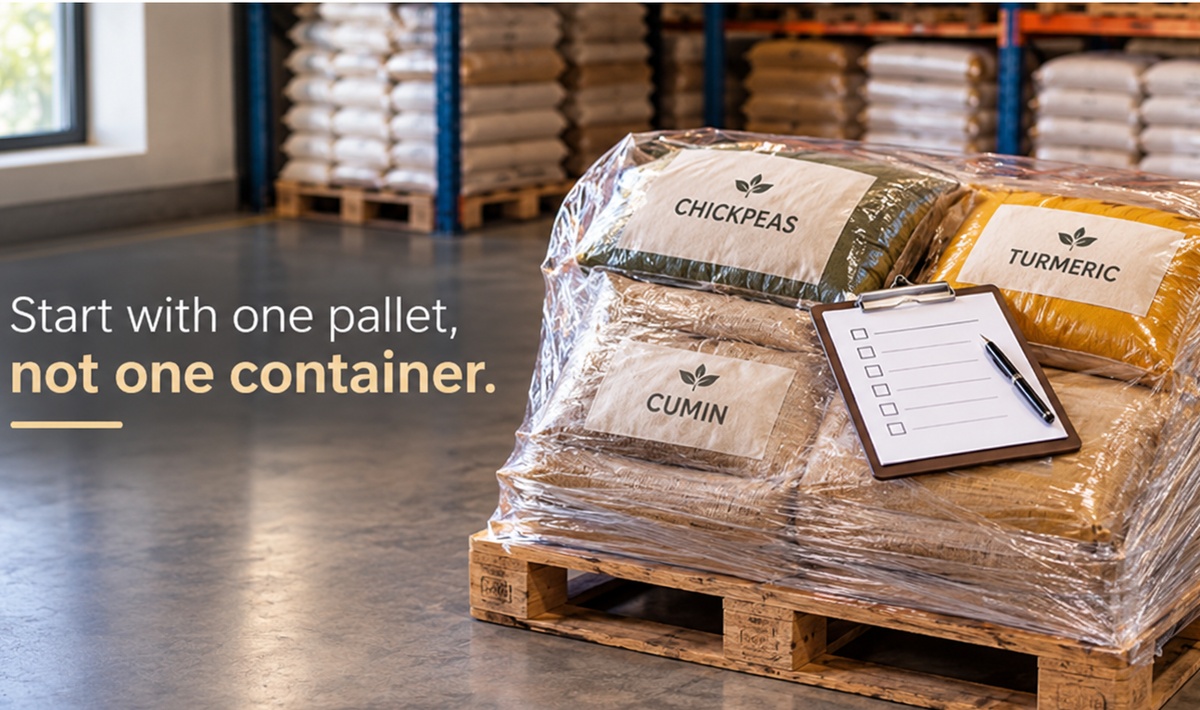
Most new importers think the only way into the Indian market is a full container, a big deposit and a leap of faith. It isn’t. The buyers who last treat the first order as research: they spend a little to learn what the supplier is really like, what the product really tests at, and what it really costs once it lands. Only then do they scale.
1. Start with one or two products
A narrow range keeps your budget, testing and learning curve manageable. Pick products you already have a buyer for, that have a clear specification, and that store well. Whole, dry products such as chickpeas, whole spices and seeds are easier to hold than ground ones, which lose aroma faster.
2. Write the specification before asking for a price
Ask five suppliers for “the price of cumin” and you get five prices for five different products. Write down the grade, cleaning level (for example, sortex-cleaned), maximum moisture, mesh size for powders, packaging and bag weight, required test reports, and your destination port. This one page makes quotes comparable and protects you in a dispute.
3. Check your own country’s rules first
Before contacting suppliers, ask your customs broker or food authority about importer registration, duties or quotas (pulses in particular face changing trade measures in some markets), labelling language, plant-health documents and residue limits. Confirm in the current month, not from an old article.
4. Verify suppliers, then climb the order ladder
Contact three to five suppliers and treat their first replies as data. Look for specific answers about origin and grade, a named contact who replies the same day, a valid IEC and, for spices, Spices Board registration (CRES), and a willingness to show the facility on video.
5. Then buy in steps instead of jumping to a container:
| Rung | What You Buy | What You Learn |
|---|---|---|
| 1. Sample | Small, sealed, lot-numbered sample | Real quality and communication speed |
| 2. Local Test | Part of the sample, tested independently | Whether it meets your country's limits |
| 3. Trial Order | A few pallets or an LCL shipment | Documents, transit time, landed cost |
| 4. Repeat Order | Larger regular Shipment | Consistency between lots |
| 5. Full Container | Standard economical shipment | Best cost per kg, once trust is learned |
Ask for a sample from the actual lot, not a hand-picked showpiece. Expect the price per kg on a trial order to be higher than on a full container. That premium is the cost of learning safely.
6. Work out the real landed cost
A factory quote is not your cost. Add packing, Indian inland and port charges, freight, marine insurance, import duty and taxes, clearance, testing, currency movement, and storage or wastage. Then divide the total by the usable kilograms you receive, not the kilograms you paid for.
7. Agree payment, Incoterm and claims in writing
For a first order, part payment in advance with the balance against shipping documents is a common compromise, and a letter of credit is safer for both sides. Avoid 100% advance to a supplier you haven’t verified, and pay only to a bank account in the company’s registered name. Write down the Incoterm (for example, FOB or CIF), what happens if goods miss the specification, and how long you have to report a problem.
Common first-order mistakes
- Ordering a full container before testing a sample
- Comparing quotes that are not on the same specification
- Checking import rules after the cargo is already at sea
- Leaving testing, clearance and storage out of the budget
- Having no buyer lined up, so stock sits unsold
The takeaway
A small budget is not a weakness in international trade. It forces the discipline big buyers sometimes skip: clear specifications, tested samples, careful costing and a gradual increase in order size. Start small, learn quickly, and scale with a supplier who has earned it.
Planning your first import of pulses, spices or herbs from India? Our export team can help with samples, specifications and trial-order options for your market.